
14 May 2009


30 May 2007
Geek Alert! My 2+ Days at ReaperCon
So May has been a busy month, with ReaperCon and the family vacation to Disney World on adjacent weekends. ReaperCon was an absolute blast. Went with my good buddy SpiderHam to two of the four day event.
Sadly, I have no pictures of my own, since my camera batteries were dead, and replacements weren't readily at hand. So, I stole some from SH...
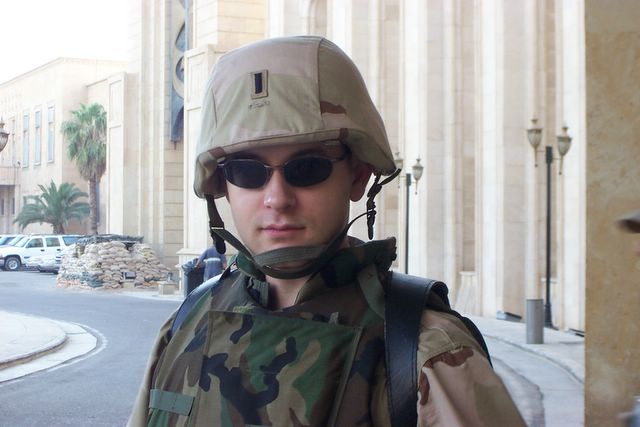
Here I am painting. Note how SH cleverly hid my suckage behind the lamp.

SH and I at the Warlord Dungeon Crawl. It was a lot of fun getting to play with $1,000 worth of dungeon and accessories.


Definitely had a good time. I have a great wife, by the way. She gives me space to do my own thing, which, I think, is the only way I could do a marriage. I bought a bag full of bits, a couple t-shirts, four bottles of paint, and several chicken sandwiches from the on-site Sonic guy. In addition to painting and playing the dungeon crawl, we played a Warlord demo (I think SH is hooked and leaning toward's buying some Razig's Revenge - the undead pirate faction). I went to a couple painting classes with professional mini painters, and we both went to a "kit bashing" class where we built our own mini out of spare parts. We also did a speed painting competition, where we had 45 minutes to do a paint job on an out of production miniature (and I can see why it's no longer on the market - no offense to the sculptor). Oh, yeah, and we had to use a set of weird-ass colors they gave us.
The result of my speed painting efforts:

My self-built mini. It's not a terribly dignified pose, but he's very unbalanced...and also he falls backward.

All is well with the universe.
Sadly, I have no pictures of my own, since my camera batteries were dead, and replacements weren't readily at hand. So, I stole some from SH...
Here I am painting. Note how SH cleverly hid my suckage behind the lamp.

SH and I at the Warlord Dungeon Crawl. It was a lot of fun getting to play with $1,000 worth of dungeon and accessories.


Definitely had a good time. I have a great wife, by the way. She gives me space to do my own thing, which, I think, is the only way I could do a marriage. I bought a bag full of bits, a couple t-shirts, four bottles of paint, and several chicken sandwiches from the on-site Sonic guy. In addition to painting and playing the dungeon crawl, we played a Warlord demo (I think SH is hooked and leaning toward's buying some Razig's Revenge - the undead pirate faction). I went to a couple painting classes with professional mini painters, and we both went to a "kit bashing" class where we built our own mini out of spare parts. We also did a speed painting competition, where we had 45 minutes to do a paint job on an out of production miniature (and I can see why it's no longer on the market - no offense to the sculptor). Oh, yeah, and we had to use a set of weird-ass colors they gave us.
The result of my speed painting efforts:

My self-built mini. It's not a terribly dignified pose, but he's very unbalanced...and also he falls backward.

All is well with the universe.
04 May 2007
The bleak 2008 Field
So the campaign is underway in earnest and it's time for me to start paying a bit more attention.
This test at SelecSmart.com gave me surprising results. I can't stand McCain, mainly because of the blatantly anti free speech Incumbent Protection Act. The only person I'm more disappointed with on that front is Bush, who disagreed, but didn't have the balls to veto, assuming instead that the Supreme Court would strike down the unconstitutional provision (it didn't).
This quiz, which may be a bit more accurate, puts Romney at only a 23% match. I was a bit surprised the libertarian Ron Paul only got 25%. It's telling that no one got over 50%, and I'm not surprised with the low agreement on social issues. Here are the top contenders.
This test at SelecSmart.com gave me surprising results. I can't stand McCain, mainly because of the blatantly anti free speech Incumbent Protection Act. The only person I'm more disappointed with on that front is Bush, who disagreed, but didn't have the balls to veto, assuming instead that the Supreme Court would strike down the unconstitutional provision (it didn't).

This quiz, which may be a bit more accurate, puts Romney at only a 23% match. I was a bit surprised the libertarian Ron Paul only got 25%. It's telling that no one got over 50%, and I'm not surprised with the low agreement on social issues. Here are the top contenders.
|  | Sam Brownback Republican Sr Senator (KS) | Biographical Profile Sam Brownback's answers Sam Brownback's stances | |||||||||||
|  | John McCain Republican Sr Senator (AZ); 2000 Primary Candidate for President | Biographical Profile John McCain's answers John McCain's stances | |||||||||||
|  | Duncan Hunter Republican Representative (CA-52) | Biographical Profile Duncan Hunter's answers Duncan Hunter's stances | |||||||||||
|  | Tom Tancredo Republican Representative (CO-6) | Biographical Profile Tom Tancredo's answers Tom Tancredo's stances | |||||||||||
|  | Rudy Giuliani Former Mayor of New York City; Republican Candidate for 2000 Senate (NY) | Biographical Profile Rudy Giuliani's answers Rudy Giuliani's stances | |||||||||||
|  | Tommy Thompson Former Secretary of H.H.S.; former Republican Governor (WI) | Biographical Profile Tommy Thompson's answers Tommy Thompson's stances | |||||||||||
27 February 2007
Genographic Project
Very cool. This project sets out to map human migration throughout history with genetic markers. Now to convince the missus I should spend $200 to get paternal and maternal mapping done....
05 January 2007
Charge!

I finally finished my first batch of Crusaders from the Warlord line. Several learning points on these: 1) Doing a brown wash over the white undercoat is dangerous if you're going to have whites and very light colors in the end product. 2) This was my first time working with gloss varnish, which I understand protects the paint job much better than matte. I used three coats of spray matte finish and one coat of brush-on varnish, but you can still see too much shine on parts of the dirt and cloth. I wonder if you can mix matte and gloss....

24 December 2006
First Diorama
Not my best work, but definitely my most time consuming Christmas gift. I got this Old Glory antitank gun and crew for my brother in law and did my first diorama.


Suicide Solution (A Christmas Story)
What a dipshit. With all the evil that has and is now being done in the name of religion, this idiot does the human torch thing over what a school district wants to call their winter break. It's not like the world isn't filled with serious examples of religion having veto power over reason and human rights.
Man Sets Self Aflame in Calif. Protest
Dec 23 10:48 AM US/Eastern
Man Sets Self Aflame in Calif. Protest
Dec 23 10:48 AM US/Eastern
A man used flammable liquid to light himself on fire, apparently to protest a San Joaquin Valley school district's decision to change the names of winter and spring breaks to Christmas and Easter vacation.
The man, who was not immediately identified, on Friday also set fire to a Christmas tree, an American flag and a revolutionary flag replica, said Fire Captain Garth Milam.
Seeing the flames, Sheriff's Deputy Lance Ferguson grabbed a fire extinguisher and ran to the man.
Flames were devouring a Christmas tree next to the Liberty Bell, where public events and demonstrations are common.
Beside the tree the man stood with an American flag draped around his shoulders and a red gas can over his head.
Seeing the deputy, the man poured the liquid over his head. He quickly burst into flames when the fumes from the gas met the flames from the tree.
The deputy ordered the man to drop to the ground as he and a parole agent sprayed him with fire extinguishers.
"The man stood there like this," the deputy said with his arms across his chest and his head bent down, "Saying no, no, no."
The man suffered first degree burns on his shoulders and arms, Milam said.
Kern County Sheriff's Deputy John Leyendecker said the man had a sign that read: "(expletive) the religious establishment and KHSD."
On Thursday, the Kern High School Board of Trustees voted to use the names Christmas and Easter instead of winter and spring breaks.
16 December 2006
D&D-Worthy Baby Names
I was inspired by a pregnant friend's humorous baby name list (which includes Beorthilde - Shining Battlemaid), to look up some other names with bitchin' fantasy meanings worthy of a Dr Pepper-fueled, late-night, dice-rolling shindig.
Longwei - Chinese. Means "Dragon greatness." I know it's pronounced "way," but it's the closest to a good wang joke I could find.
Malandra - English. Blend of Malinda ("Dark Serpent") and Sandra ("Defender of Mankind").
Medousa - Just Greek for Medusa, but coolness factor added by the fact that in looks like it's being said by some thick-necked flunky from the Godfather.
Afreda - Unknown. "Elf Power." Eeeelf Poweeeeer!
Alva - German. Army of Elves.
Alberich - Norse. A mythic Dwarf.
Napoleon - French of Germanic origin. From "Sons of the Mist," - the name of a race of dwarves. Isn't it ironic, doncha think?
Oberon - Shakespeare. King of Fairies. (This is now my new pejorative for my little brother) :)
Eginhard - German. "Sword Power." Swooooord Poweeeeer!
Melvin - English. "Sword Friend." Who knew?
Gordon - Scottish clan name. "From the roomy fort." I wonder whether they were bragging, or trying to convince themselves.
Harvey - English. "Eager for battle; strong and worthy." Again, who knew?
Duncan - Scottish. "Brown Fighter." OK, nothing to do with the theme, but it's now the new name of my pooper-scooper.
Longwei - Chinese. Means "Dragon greatness." I know it's pronounced "way," but it's the closest to a good wang joke I could find.
Malandra - English. Blend of Malinda ("Dark Serpent") and Sandra ("Defender of Mankind").
Medousa - Just Greek for Medusa, but coolness factor added by the fact that in looks like it's being said by some thick-necked flunky from the Godfather.
Afreda - Unknown. "Elf Power." Eeeelf Poweeeeer!
Alva - German. Army of Elves.
Alberich - Norse. A mythic Dwarf.
Napoleon - French of Germanic origin. From "Sons of the Mist," - the name of a race of dwarves. Isn't it ironic, doncha think?
Oberon - Shakespeare. King of Fairies. (This is now my new pejorative for my little brother) :)
Eginhard - German. "Sword Power." Swooooord Poweeeeer!
Melvin - English. "Sword Friend." Who knew?
Gordon - Scottish clan name. "From the roomy fort." I wonder whether they were bragging, or trying to convince themselves.
Harvey - English. "Eager for battle; strong and worthy." Again, who knew?
Duncan - Scottish. "Brown Fighter." OK, nothing to do with the theme, but it's now the new name of my pooper-scooper.
03 November 2006
1, 2, 3, 4, Could We Please Have A Fuckin' War?
Alright, the war. I've been past the ever-present urge to stick a gun in my mouth for a while now, and until fairly recently I've been in a phase where I just take my goddamn pills and more or less try to ignore the larger world. Now I'm just pissed off.
Things I'm not going to address: 1. Myself. 2. The ridiculous, shit-for-brains arguments that have surrounded this issue (blood for oil, nuke 'em all, 911 conspiracies, presidential daddy issues, etc.). 3. Afghanistan, as in hindsight most everyone agrees on this one, some forgetting their prior drivel about a central Asian pipeline.
Premise 1: Governments rightfully exist for the protection of their citizens, both of their innate rights and of their physical safety.
Premise 2: Militaries are instruments of force.
Conclusion: The proper use of the military instrument is to employ force in pursuit of the rights and safety of citizens.
What's wrong with the war in Iraq:
Fundamentally, our error in Iraq is a failure from the beginning to properly employ the military instrument. Having made the decision to employ force, half-measures are a recipe for disaster. Failure to lean on Turkey as successfully as we did on Pakistan resulted in a massive reduction in the force brought to bear on Iraq during the invasion. Failure to see the long road ahead (mission accomplished, greeted as liberators, etc) led to an 'end to major hostilities' far too quickly and before the military instrument had been brought fully to bear throughout much of the country. Failure to stomach what had to be done in Fallujah for nearly a year created far more bloodshed than the eventual solution. The list goes on.
Underlying this failure is an unwillingness to face certain realities. Primary among these, is that force is the opposite of freedom. In fact, it's the opposite of reason, reason and force both being means. My meaning here is that the use of force is by definition a removal of the freedom of the recipient of that force. You can, contrary to the popular argument, "impose democracy at the end of a gun" (see Germany, Japan), but you cannot execute a military action (force) while at the same time extending freedom to the target of that action.
We have in this administration all the idealism of the Kennedy years tempered by none of the realism of Truman or Reagan, the latter of which combined realism and idealism fairly well, in my opinion. In their rush to create a democracy in the 'heart of the Middle East', they have hobbled our ability to win the war that still rages. Iraq now has a president who is literally three degrees of separation from Iran, which is one of the two great enemies of the U.S. and with which we are now engaging in a proxy war in Iraq. Sadr, without whom Talabani would not be in power, is Ahmadinejad's chief lieutenant in Iraq. We've just been ordered out of Sadr City in Baghdad by this puppet of a president--and complied!
We occupied and ran Japan for seven years. Their new constitution, imposed by us, went into effect two full years after the war's end. In it, we stripped the Emperor of all practical power, instituted three coequal branches of government, demilitarized the country, and enshrined human rights and nondiscrimination. This in a country with a very distinct, non western culture where people literally worshiped the Emperor as a god. Iraq is not Japan, of course, not the least because it is three separate non western cultures in conflict with one another, but this argues all the more for an approach more similar to Japan, 1945. Instead, we have a constitution a year after the conflict began created by a committee including the enemy! It enshrines Islam while paying lip service to freedom and human rights. While the conflict drags on, we kowtow to a government with which we're half-way at war, because we're apparently no longer made of the stern stuff that enabled our grandfathers to create thriving, economically powerful republics out of the dust of dictatorship.
Thoughts on common arguments:
WMDs:
They weren't there. Major failure of the world intelligence community, not an invention of Bush's addled brain. The administration's failure was in relying on this rational almost exclusively, even though it certainly wasn't the only reason for the war. We've been at war with Iraq since 1991. They never complied with the ceasefire agreement, attempted to assassinate two presidents, and were a rogue state in the center of an volatile region. A dictator has no more right to rule than a mugger has to mug, and anyone with a purpose other than to become the new dictator has a moral right (though not an imperative) to off the sonofabitch.
Saddam was bad / There are a lot of other baddies:
Both sides of this discussion are, of course, technically true. The administration flipped to this argument when the WMD branding evaporated. Everything they say in support of this argument is absolutely true. Saddam and his regime were unspeakably, undeniably evil, but that was not the only, or even the chief reason for going to war, which leaves them open for the standard response: Sudan, Zimbabwe, Cuba, China, North Korea, and others all have bad regimes doing bad things to their people, but we're not invading them. I doubt most who raise this argument actually favor intervention in any of these places, but that doesn't excuse the administration's sloppy and perhaps disingenuous argumentation. The real and justifiable reason we went to war with Iraq is that they were a threat to us and our allies. Reasonable arguments can be had about the severity the threat Iraq posed and how this compared to various other threats, but not the existence of the threat. The reality employers of the second argument should admit is that to actually intervene in a situation, we must have a reasonable chance of success when compared with the risks. Clearly we're not succeeding in Iraq, but few would argue that our probability of success vs. risk is better in Iran or North Korea. I would also argue based on the above premises that humanitarianism alone is not an imperative for use of the military instrument, which puts me at odds with both the administrations' argument an the instincts of many good folks on all sides of this issue.
Osama:
He's a motherfucker, but he's not the only one, or even, any longer, a principal. The folks most likely to use the 'there are bad regimes all over' argument usually also seem unnaturally focused on this guy while others plan and execute terrorism in planes, trains, and automobiles the world over--not to mention buses, restaurants, subways, and nightclubs.
Pull out now:
This is almost in the 'not to be addressed category', but I think it's a position arrived at honestly, though emotionally by a lot of people. The instinct is understandable, and one I share, "things are fucked up, let's get the hell out." The reality is, however, that a pullout would create a situation much more threatening to the U.S. and our interests than Saddam's regime before the invasion.
Stay the course:
The course is wrong! Fiddle or dance, shit or get off the pot, and so forth, already! This is pure political branding and it's as just as despicable as the opposition politicians' spurious 'bring the boys home' positioning. What we need is to win, to succeed. This recent bullshit about changing tactics is just that, bullshit. Of course we change combat tactics, what we need is to change strategy, to commit to victory even (or especially) if it means abandoning our altruistic fantasies.
Finally:
I don't have all the answers. There are a lot of hard and undesirable choices that need to be made, and I'm not sure what the right course is in every instance. My point is, I have a family to feed and it's ultimately out of my control--these are not my choices to make. What pisses me off is that the people we entrust to make the difficult choices that will affect all of us for decades aren't having an honest and open debate with the good of the country at heart about what we should actually do. Washington is full of Neros fiddling via soundbite while Baghdad burns.
Things I'm not going to address: 1. Myself. 2. The ridiculous, shit-for-brains arguments that have surrounded this issue (blood for oil, nuke 'em all, 911 conspiracies, presidential daddy issues, etc.). 3. Afghanistan, as in hindsight most everyone agrees on this one, some forgetting their prior drivel about a central Asian pipeline.
Premise 1: Governments rightfully exist for the protection of their citizens, both of their innate rights and of their physical safety.
Premise 2: Militaries are instruments of force.
Conclusion: The proper use of the military instrument is to employ force in pursuit of the rights and safety of citizens.
What's wrong with the war in Iraq:
Fundamentally, our error in Iraq is a failure from the beginning to properly employ the military instrument. Having made the decision to employ force, half-measures are a recipe for disaster. Failure to lean on Turkey as successfully as we did on Pakistan resulted in a massive reduction in the force brought to bear on Iraq during the invasion. Failure to see the long road ahead (mission accomplished, greeted as liberators, etc) led to an 'end to major hostilities' far too quickly and before the military instrument had been brought fully to bear throughout much of the country. Failure to stomach what had to be done in Fallujah for nearly a year created far more bloodshed than the eventual solution. The list goes on.
Underlying this failure is an unwillingness to face certain realities. Primary among these, is that force is the opposite of freedom. In fact, it's the opposite of reason, reason and force both being means. My meaning here is that the use of force is by definition a removal of the freedom of the recipient of that force. You can, contrary to the popular argument, "impose democracy at the end of a gun" (see Germany, Japan), but you cannot execute a military action (force) while at the same time extending freedom to the target of that action.
We have in this administration all the idealism of the Kennedy years tempered by none of the realism of Truman or Reagan, the latter of which combined realism and idealism fairly well, in my opinion. In their rush to create a democracy in the 'heart of the Middle East', they have hobbled our ability to win the war that still rages. Iraq now has a president who is literally three degrees of separation from Iran, which is one of the two great enemies of the U.S. and with which we are now engaging in a proxy war in Iraq. Sadr, without whom Talabani would not be in power, is Ahmadinejad's chief lieutenant in Iraq. We've just been ordered out of Sadr City in Baghdad by this puppet of a president--and complied!
We occupied and ran Japan for seven years. Their new constitution, imposed by us, went into effect two full years after the war's end. In it, we stripped the Emperor of all practical power, instituted three coequal branches of government, demilitarized the country, and enshrined human rights and nondiscrimination. This in a country with a very distinct, non western culture where people literally worshiped the Emperor as a god. Iraq is not Japan, of course, not the least because it is three separate non western cultures in conflict with one another, but this argues all the more for an approach more similar to Japan, 1945. Instead, we have a constitution a year after the conflict began created by a committee including the enemy! It enshrines Islam while paying lip service to freedom and human rights. While the conflict drags on, we kowtow to a government with which we're half-way at war, because we're apparently no longer made of the stern stuff that enabled our grandfathers to create thriving, economically powerful republics out of the dust of dictatorship.
Thoughts on common arguments:
WMDs:
They weren't there. Major failure of the world intelligence community, not an invention of Bush's addled brain. The administration's failure was in relying on this rational almost exclusively, even though it certainly wasn't the only reason for the war. We've been at war with Iraq since 1991. They never complied with the ceasefire agreement, attempted to assassinate two presidents, and were a rogue state in the center of an volatile region. A dictator has no more right to rule than a mugger has to mug, and anyone with a purpose other than to become the new dictator has a moral right (though not an imperative) to off the sonofabitch.
Saddam was bad / There are a lot of other baddies:
Both sides of this discussion are, of course, technically true. The administration flipped to this argument when the WMD branding evaporated. Everything they say in support of this argument is absolutely true. Saddam and his regime were unspeakably, undeniably evil, but that was not the only, or even the chief reason for going to war, which leaves them open for the standard response: Sudan, Zimbabwe, Cuba, China, North Korea, and others all have bad regimes doing bad things to their people, but we're not invading them. I doubt most who raise this argument actually favor intervention in any of these places, but that doesn't excuse the administration's sloppy and perhaps disingenuous argumentation. The real and justifiable reason we went to war with Iraq is that they were a threat to us and our allies. Reasonable arguments can be had about the severity the threat Iraq posed and how this compared to various other threats, but not the existence of the threat. The reality employers of the second argument should admit is that to actually intervene in a situation, we must have a reasonable chance of success when compared with the risks. Clearly we're not succeeding in Iraq, but few would argue that our probability of success vs. risk is better in Iran or North Korea. I would also argue based on the above premises that humanitarianism alone is not an imperative for use of the military instrument, which puts me at odds with both the administrations' argument an the instincts of many good folks on all sides of this issue.
Osama:
He's a motherfucker, but he's not the only one, or even, any longer, a principal. The folks most likely to use the 'there are bad regimes all over' argument usually also seem unnaturally focused on this guy while others plan and execute terrorism in planes, trains, and automobiles the world over--not to mention buses, restaurants, subways, and nightclubs.
Pull out now:
This is almost in the 'not to be addressed category', but I think it's a position arrived at honestly, though emotionally by a lot of people. The instinct is understandable, and one I share, "things are fucked up, let's get the hell out." The reality is, however, that a pullout would create a situation much more threatening to the U.S. and our interests than Saddam's regime before the invasion.
Stay the course:
The course is wrong! Fiddle or dance, shit or get off the pot, and so forth, already! This is pure political branding and it's as just as despicable as the opposition politicians' spurious 'bring the boys home' positioning. What we need is to win, to succeed. This recent bullshit about changing tactics is just that, bullshit. Of course we change combat tactics, what we need is to change strategy, to commit to victory even (or especially) if it means abandoning our altruistic fantasies.
Finally:
I don't have all the answers. There are a lot of hard and undesirable choices that need to be made, and I'm not sure what the right course is in every instance. My point is, I have a family to feed and it's ultimately out of my control--these are not my choices to make. What pisses me off is that the people we entrust to make the difficult choices that will affect all of us for decades aren't having an honest and open debate with the good of the country at heart about what we should actually do. Washington is full of Neros fiddling via soundbite while Baghdad burns.
26 October 2006
Evolution for Dummies
From a Scientific American list of 15 common attacks on evolution. I'll spare the more mundane or ridiculous items (semantics about 'theory', no one has seen evolution, etc).
6. If humans descended from monkeys, why are there still monkeys?
This surprisingly common argument reflects several levels of ignorance about evolution. The first mistake is that evolution does not teach that humans descended from monkeys; it states that both have a common ancestor.
The deeper error is that this objection is tantamount to asking, "If children descended from adults, why are there still adults?" New species evolve by splintering off from established ones, when populations of organisms become isolated from the main branch of their family and acquire sufficient differences to remain forever distinct. The parent species may survive indefinitely thereafter, or it may become extinct.
8. Mathematically, it is inconceivable that anything as complex as a protein, let alone a living cell or a human, could spring up by chance.
This explanation is good, but leaves out a key element--the vast amount of time over which natural selection has in which to work. Similarly to the vastness of space, the vastness of time is something we all have trouble wrapping our minds around. We can look at the numbers in scientific notiation, even read examples and comparisons, but at the end of the day time and space are too vast for us to really take their measure in a way we can internalize.
Chance plays a part in evolution (for example, in the random mutations that can give rise to new traits), but evolution does not depend on chance to create organisms, proteins or other entities. Quite the opposite: natural selection, the principal known mechanism of evolution, harnesses nonrandom change by preserving "desirable" (adaptive) features and eliminating "undesirable" (nonadaptive) ones. As long as the forces of selection stay constant, natural selection can push evolution in one direction and produce sophisticated structures in surprisingly short times. As an analogy, consider the 13-letter sequence "TOBEORNOTTOBE." Those hypothetical million monkeys, each pecking out one phrase a second, could take as long as 78,800 years to find it among the 2613 sequences of that length. But in the 1980s Richard Hardison of Glendale College wrote a computer program that generated phrases randomly while preserving the positions of individual letters that happened to be correctly placed (in effect, selecting for phrases more like Hamlet's). On average, the program re-created the phrase in just 336 iterations, less than 90 seconds. Even more amazing, it could reconstruct Shakespeare's entire play in just four and a half days.
11. Natural selection might explain microevolution, but it cannot explain the origin of new species and higher orders of life.
Evolutionary biologists have written extensively about how natural selection could produce new species. For instance, in the model called allopatry, developed by Ernst Mayr of Harvard University, if a population of organisms were isolated from the rest of its species by geographical boundaries, it might be subjected to different selective pressures. Changes would accumulate in the isolated population. If those changes became so significant that the splinter group could not or routinely would not breed with the original stock, then the splinter group would be reproductively isolated and on its way toward becoming a new species. Natural selection is the best studied of the evolutionary mechanisms, but biologists are open to other possibilities as well. Biologists are constantly assessing the potential of unusual genetic mechanisms for causing speciation or for producing complex features in organisms. Lynn Margulis of the University of Massachusetts at Amherst and others have persuasively argued that some cellular organelles, such as the energy-generating mitochondria, evolved through the symbiotic merger of ancient organisms. Thus, science welcomes the possibility of evolution resulting from forces beyond natural selection. Yet those forces must be natural; they cannot be attributed to the actions of mysterious creative intelligences whose existence, in scientific terms, is unproved.
14. Living things have fantastically intricate features--at the anatomical, cellular and molecular levels--that could not function if they were any less complex or sophisticated. The only prudent conclusion is that they are the products of intelligent design, not evolution.
This "argument from design" is the backbone of most recent attacks on evolution, but it is also one of the oldest. In 1802 theologian William Paley wrote that if one finds a pocket watch in a field, the most reasonable conclusion is that someone dropped it, not that natural forces created it there. By analogy, Paley argued, the complex structures of living things must be the handiwork of direct, divine invention. Darwin wrote On the Origin of Species as an answer to Paley: he explained how natural forces of selection, acting on inherited features, could gradually shape the evolution of ornate organic structures.
Generations of creationists have tried to counter Darwin by citing the example of the eye as a structure that could not have evolved. The eye's ability to provide vision depends on the perfect arrangement of its parts, these critics say. Natural selection could thus never favor the transitional forms needed during the eye's evolution--what good is half an eye? Anticipating this criticism, Darwin suggested that even "incomplete" eyes might confer benefits (such as helping creatures orient toward light) and thereby survive for further evolutionary refinement. Biology has vindicated Darwin: researchers have identified primitive eyes and light-sensing organs throughout the animal kingdom and have even tracked the evolutionary history of eyes through comparative genetics. (It now appears that in various families of organisms, eyes have evolved independently.)
Today's intelligent-design advocates are more sophisticated than their predecessors, but their arguments and goals are not fundamentally different. They criticize evolution by trying to demonstrate that it could not account for life as we know it and then insist that the only tenable alternative is that life was designed by an unidentified intelligence.16 October 2006
Minis: First Commission
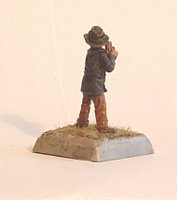
So my buddy asked me to paint the cool 1940's sleuth mini he's using in his Star Wars game.
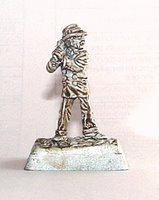
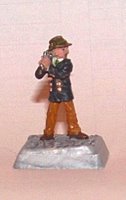
In process.

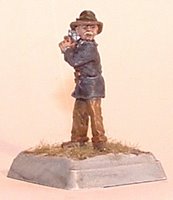
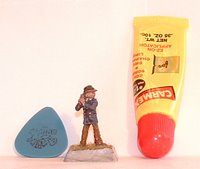
The finished product, and something for size reference.

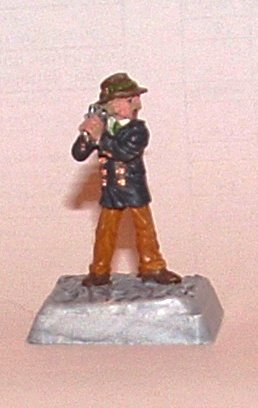
In process.




The finished product, and something for size reference.
Subscribe to:
Posts (Atom)